
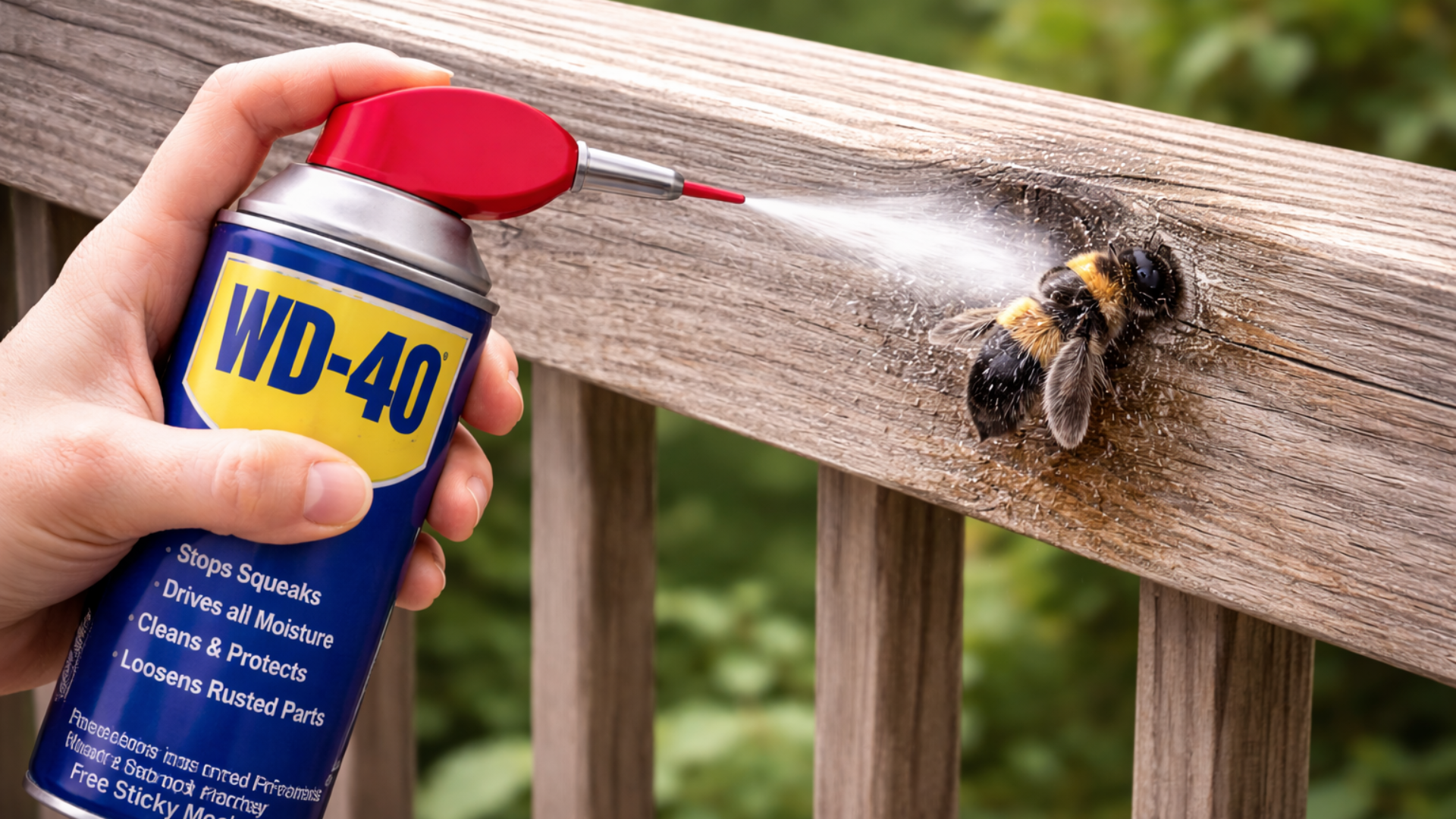
If you’ve ever noticed big black bees hovering around your deck, porch, or wooden railings — and then spotted neat little round holes drilled into the wood — you’re probably dealing with carpenter bees. They look harmless (and honestly, kind of cute), but the damage they leave behind can add up fast if they keep nesting in the same spots year after year.
Carpenter bees don’t eat wood — they tunnel into it to build nests for their eggs. Over time, those tunnels weaken boards, attract more bees, and turn solid wood into a hidden mess inside. The problem isn’t the bees themselves — it’s the repeated nesting that slowly destroys your structure.
That’s why a lot of homeowners look for fast, accessible solutions — and one surprisingly common household product people use is WD-40.
Why WD-40 Is Used for Carpenter Bees
WD-40 isn’t an insecticide, but it does work on carpenter bees when used directly. The spray is strong, penetrating, and suffocates insects on contact. When sprayed into carpenter bee holes, it can reach deep into their tunnels and drive them out or kill them inside the nest.
People like using it because:
-
It’s already in most garages
-
It’s inexpensive
-
It works immediately
-
It reaches deep into drilled holes
-
It’s easy to apply with the straw nozzle
It’s not a perfect long-term solution by itself — but it’s very effective as a quick-action treatment when bees are actively nesting.
If you want to know some more wd-40 uses you can check this article out “14 unusual wd-40 household hacks”.
How to Use WD-40 to Get Rid of Carpenter Bees
Here’s the simple, practical way to use it:
Step 1: Find the Active Holes
Look for small round holes in wood, usually under decks, porch railings, eaves, fascia boards, and outdoor furniture. You’ll often see fine sawdust beneath them.
Step 2: Choose the Right Time
Early morning or evening works best, when bees are more likely to be inside the tunnels instead of flying around.
Step 3: Use the Straw Nozzle
Attach the thin red straw to the WD-40 can. This lets you spray directly into the hole instead of just on the surface.
Step 4: Spray Into the Tunnel
Insert the straw into the hole and spray for a few seconds. This pushes the product deep into the nest chamber.
Step 5: Repeat Over a Few Days
Not all bees will be inside at the same time. Repeating the process helps catch any that return.
How to kill carpenter bees with wd-40
To get rid of carpenter bees with wd-40 is pretty simple just make sure to do the following:
- Wear protective gear– It’s pretty obvious why it’s important to wear protective gear while getting ready to exterminate bees.
- Find the bee’s nest– Check for small holes that are about 1/2 to 1 inch deep. These holes usually have sawdust below them and you may see some yellow stains around the holes.
- Spray the nest– Spray the nest with wd-40. Use the straw of the wd-40 bottle and place it inside the holes and spray. Do this for 3 days until all the bees are dead.
- Cover the holes- Cover the nest holes with caulk.
This is the best way to use wd-40 to kill carpenter bees.
Other Simple Options That Help
If you want to strengthen your defense, you can combine WD-40 with:
✔ Carpenter Bee Traps
They lure bees in and trap them without chemicals.
✔ Repellent Sprays
Strong scents like peppermint, citrus, or eucalyptus can discourage nesting.
✔ Wood Protection
Painting, staining, sealing, or wrapping exposed wood edges.
✔ Preventative Maintenance
Filling old holes before spring starts stops new nesting cycles.
Important Safety Notes
WD-40 is a petroleum-based product, not a pest control spray. That means:
-
Use it outdoors only
-
Avoid spraying near pets, kids, or plants
-
Wear gloves
-
Avoid breathing in the fumes
-
Don’t use near flames or heat
It’s a targeted solution, not something to spray everywhere.
How to get rid of carpenter bees without killing them
This is more of a way to prevent carpenter bees from making nests inside the wooden areas of your home. To do this all you have to do is spray any wooden areas you think that bees will want to build a nest in.
The strong scent of wd-40 will definitely keep the carpenter bees away.
How to Prevent Carpenter Bees Long-Term
This is what actually keeps them away year after year:
-
Seal all old holes
-
Paint or stain bare wood
-
Repair soft or rotting boards
-
Inspect wood every spring
-
Protect exposed edges and corners
-
Don’t leave raw wood untreated outdoors
Carpenter bees are creatures of habit — if a spot feels safe, they’ll keep coming back.
What Most People Miss (And Why Bees Come Back)
Spraying alone isn’t enough.
This is the part most people skip — and it’s why carpenter bees return the next season.
Once the bees are gone:
Seal the Holes
Use wood filler, caulk, or wooden dowels to plug the tunnels completely.
Sand and Paint or Seal
Carpenter bees love bare, untreated wood. Painting or sealing the surface makes it far less attractive to them.
If you don’t seal the holes, new bees will reuse the same tunnels — even years later.
Final Thoughts
WD-40 can absolutely work for carpenter bees when used correctly — especially as a fast, direct solution for active nests. But the real fix isn’t just spraying — it’s sealing, protecting, and preventing.
Think of WD-40 as the first step, not the only step.
When you combine treatment + sealing + wood protection, you don’t just get rid of the bees — you stop the cycle entirely.
And that’s how you protect your porch, deck, and home for good 🐝🏡

Comments are closed.